
EMPD Energy Efficient Motors
Region
Get a quote
Sales & engineering

[email protected]
+91 99445 93322 · WhatsApp

North America · Europe & UK

[email protected]
+1 (215) 800-9836 · +44 7424 878268

Works

S.F. No. 450/3A, Annai Nagar, Othakalmandapam Road, Chettipalayam, Coimbatore 641 201, Tamil Nadu, India

42,200kWh saved a year, 40 pumps
30 tCO₂ avoided a year
1.7 mmimpeller trim that unlocks it

The plant

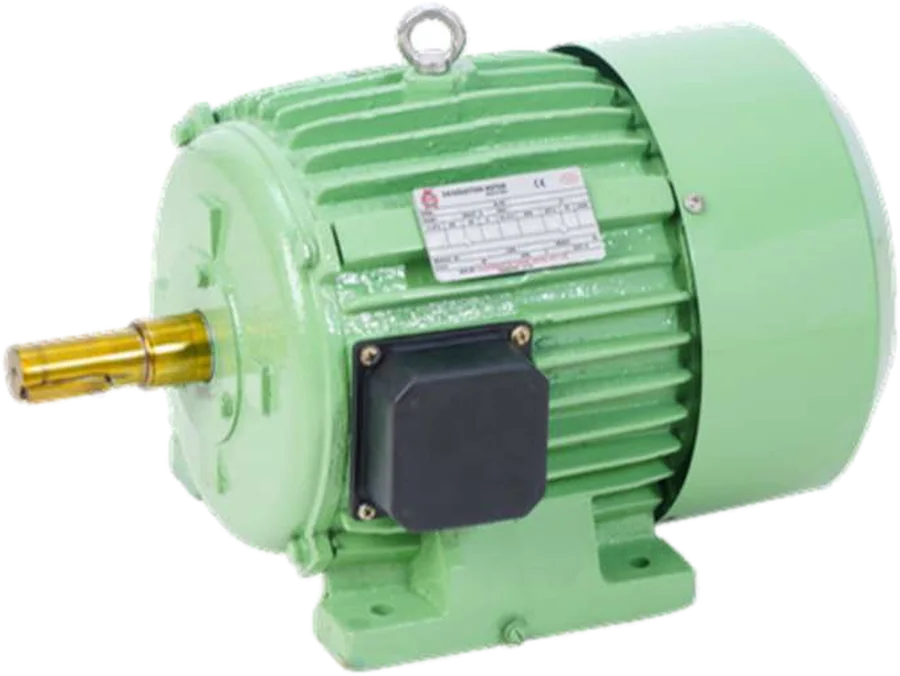
A plant runs 40 centrifugal pumps, each driven by an 11 kW 4-pole motor working at about 75 % load for 6,000 hours a year. The proposal: replace the IE2 motors with IE3.

Step 1 · The simple calculation

EMPD tested values at 75 % load: IE2 EM2-160M-4-11 91.0 %; IE3 EM3-160M-4-11 92.8 %.

Shaft power 8.25 kW IE2 input 8.25 ÷ 0.910 = 9.066 kW IE3 input 8.25 ÷ 0.928 = 8.890 kW Saving 0.176 kW × 6,000 h = 1,055 kWh per motor per year

Step 2 · The slip effect

An IE3 motor has lower losses, so it slips less: 1,475 rpm against 1,465 rpm for the IE2. A centrifugal pump's power rises with the cube of speed.

Speed ratio 1,475 ÷ 1,465 = 1.0068 Power ratio 1.0068³ = 1.0206 (+2.1 %) IE3 shaft power 8.25 × 1.0206 = 8.42 kW IE3 input 8.42 ÷ 0.928 = 9.073 kW → no saving at all

The pump now delivers about 0.7 % more flow and head than the process needs, and the extra is throttled away in the valve. The efficiency gain is spent on pumping water the plant does not use.

Step 3 · Unlocking the saving

Bring the pump back to its duty point. By the affinity laws, trimming the impeller in proportion to the speed increase does it:

Trim ratio 1,465 ÷ 1,475 = 0.9932 250 mm impeller → 248.3 mm (1.7 mm trim)

Where pumps run on variable-speed drives, the controller does this automatically. With the duty point restored, each motor saves the full 1,055 kWh a year.

Fleet saving 1,055 × 40 = 42,200 kWh a year CO₂ avoided × 0.716 kg/kWh (India grid) = 30 t a year

Step 4 · Power factor

The IE3 motor's power factor at 75 % load is 0.75 against 0.78 for the IE2. Across 40 motors the plant's reactive demand rises slightly; check the capacitor bank setting at commissioning.

Result

The IE3 retrofit saves about 42,200 kWh and 30 t of CO₂ a year, but only if the pumps are trimmed or speed-controlled. EMPD's application engineers run this check on every pump and fan retrofit enquiry. Try your own numbers in the energy savings tool.

Application study: an engineering example worked by EMPD with catalogue data. Your application is confirmed by our engineers before quotation. Send us your duty.
More applications

Hoists & cranes

A 5-tonne hoist: sizing the motor, the brake and its heat

Brake torque is the easy part of a hoist drive. The question that decides brake life is how much energy the brake must absorb on every stop, at 240 stops an hour.

Material handling · North America

A 460 V conveyor drive: 10 HP that can carry 12.5 HP

A North American conveyor needs 9 HP continuously with peaks to 11.5 HP. Choosing the motor means reading nameplate HP, service factor, starting torque and the overload setting together.

Fans & blowers

Starting a heavy fan: 3.7 seconds, not 14

A large fan has little load torque at low speed but a great deal of inertia. The starting time decides whether the motor survives the start, and the starting method changes it four-fold.

Pumps & conveyors

Star-delta or direct on line? It depends on the load

Star-delta starting cuts the starting current to a third. It also cuts the starting torque to a third, which a pump can live with and a loaded conveyor cannot.

Textile & process lines

Constant torque at low speed on an inverter

A self-ventilated motor cools less as it slows. Running full torque down to 10 Hz needs a different cooling method, not simply a bigger motor.

Workshops & buildings

A single-phase compressor that has to start under pressure

Reciprocating compressors often restart against pressure in the cylinder. The capacitor design, not the kW rating, decides whether the motor turns.

Mining & remote sites

High and hot: derating for altitude and ambient

Ratings assume 1,000 m and 40 °C. At a 2,500 m site in 45 °C heat, thinner air and hotter surroundings both cut cooling, and the two effects multiply.

Hoists, lifts & automation

Running a brake motor on an inverter

On an inverter, the drive does the stopping and the brake does the holding. Getting the supply and the timing right keeps both safe and lets the brake last for years.

Valve actuators

Valve actuator motors: torque to unseat, not power to run

An actuator motor runs for seconds or minutes at a time but must break a seated valve free. Starting torque and short-time duty decide the motor, not continuous kW.

Let’s build your motor.

Send us output, speed, supply, mounting, duty and quantity. Our engineers reply with a recommendation and a quotation.