
EMPD Energy Efficient Motors
Region
Get a quote
Sales & engineering

[email protected]
+91 99445 93322 · WhatsApp

North America · Europe & UK

[email protected]
+1 (215) 800-9836 · +44 7424 878268

Works

S.F. No. 450/3A, Annai Nagar, Othakalmandapam Road, Chettipalayam, Coimbatore 641 201, Tamil Nadu, India

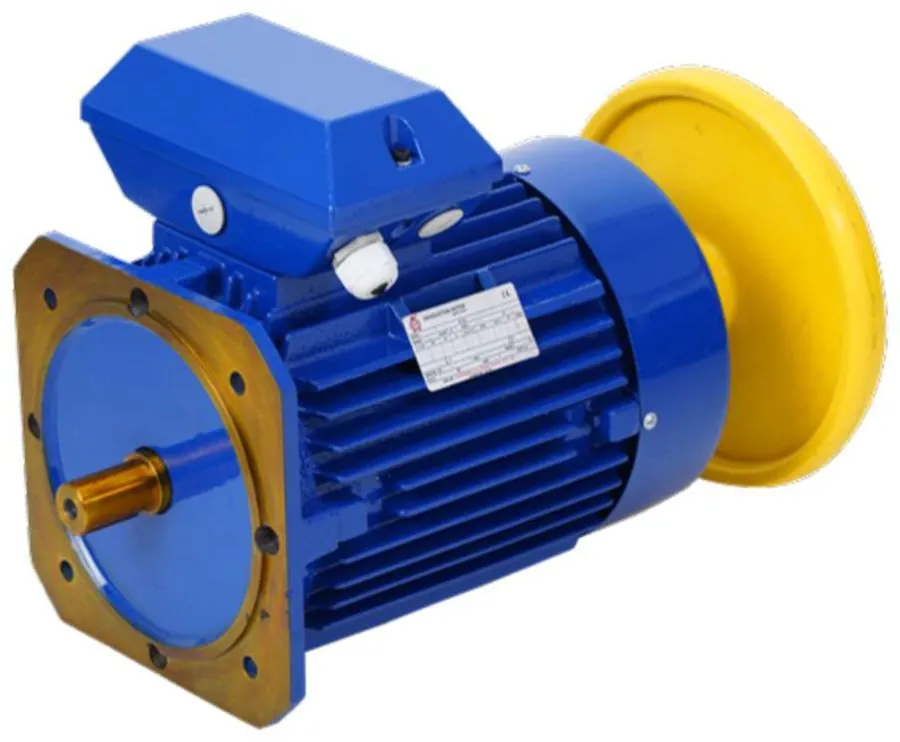
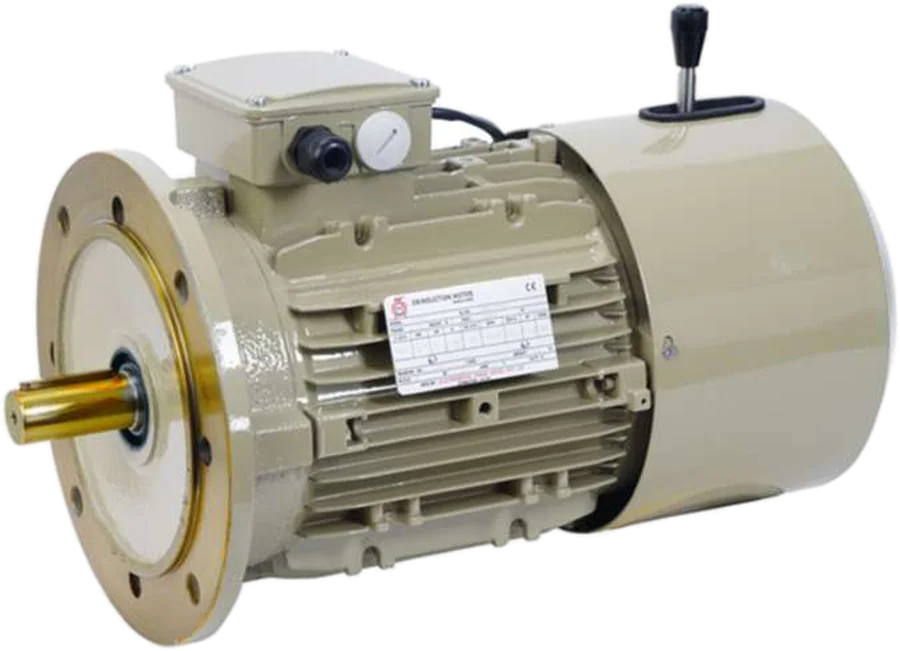
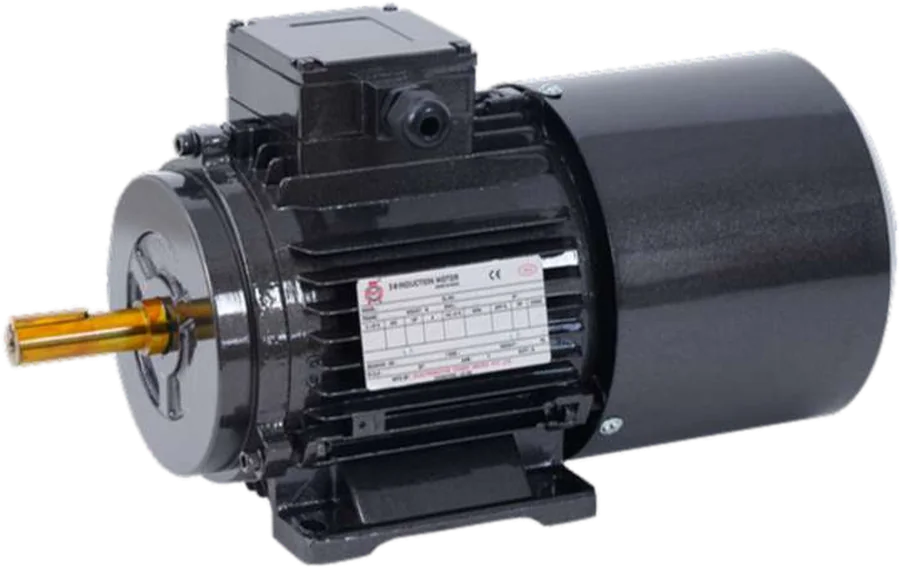
11 kWS4 brake motor, 4 pole
2.7×brake safety over 125 % test load
2.4×thermal margin per stop

The duty

An electric wire-rope hoist lifts 5,000 kg at 8 m/min through a gearbox and rope drum with an overall efficiency of 80 %. The hoist works FEM 2m class: 40 % cyclic duration factor and up to 240 starts per hour. The brake must hold a 125 % test load and stop the load quickly when lowering.

Step 1 · Motor power

P = m · g · v ÷ η = 5,000 × 9.81 × 0.1333 ÷ 0.80 = 8,175 W = 8.2 kW

The next EMPD S4 brake motor is EBM-D160M-4-11: 11 kW, 1,465 rpm, MN 71.7 Nm, starting torque 2.5 × MN. The load torque reflected to the motor shaft is 53.3 Nm when hoisting (74 % of rated torque), leaving a comfortable reserve for the S4 duty.

Step 2 · Brake torque

For hoists we select the brake at about 200 % of motor torque. The catalogue selection for this rating is EBD-19 at 144 Nm. The static load torque at the motor is 42.6 Nm, so even with the 125 % test load the brake holds with a safety factor of 144 ÷ (1.25 × 42.6) = 2.7.

Step 3 · Energy per stop: the check most selections skip

When lowering, the load drives the motor and the brake must absorb the kinetic energy of everything rotating plus the work done by the descending load during the stop.

ω = 2π × 1,465 ÷ 60 = 153.4 rad/s J = 1.2 × 0.068 + J_load = 0.0854 kgm² (gear inertia +20 %, load 0.0038) T_net = T_brake − T_load,lowering = 144 − 34.1 = 109.9 Nm t_stop = J · ω ÷ T_net = 119 ms W = T_brake × ω × t_stop ÷ 2 = 1,317 J → 1,975 J with a 1.5 allowance for brake response

The EBD-19 thermal table allows about 4.8 kJ per stop at 240 stops/h (interpolated between 12 kJ at 100 stops/h and 3.8 kJ at 300 stops/h). The design uses about 40 % of that, a margin of 2.4×, so the friction lining stays within its rating at full duty. The load stops within about 8 mm of travel plus the brake response time.

Step 4 · Details that make it work

  • Switch the DC brake on the DC side. Switching on the AC side lengthens the engagement time roughly six-fold, which lets the load creep and multiplies the energy per stop.
  • Thermistors in the winding protect against overheating at 240 starts an hour, where a current relay alone reacts too slowly.
  • Manual release lever lets maintenance lower the load safely after a power loss.
  • If the hoist moves to an inverter drive, feed the brake from a separate supply, never from the inverter output.

Result

An 11 kW S4 brake motor with a 144 Nm DC brake meets the duty with margin on power, holding torque and brake heat. The same three checks apply to every hoist enquiry EMPD receives, and our engineers confirm them before quoting.

Application study: an engineering example worked by EMPD with catalogue data. Your application is confirmed by our engineers before quotation. Send us your duty.
More applications

Material handling · North America

A 460 V conveyor drive: 10 HP that can carry 12.5 HP

A North American conveyor needs 9 HP continuously with peaks to 11.5 HP. Choosing the motor means reading nameplate HP, service factor, starting torque and the overload setting together.

Pumps & utilities

Forty pump motors, IE2 to IE3: where the savings really come from

Replacing IE2 pump motors with IE3 looks like simple arithmetic. On centrifugal pumps, the faster IE3 motor quietly raises the pump load and can cancel the saving. Here is the full calculation.

Fans & blowers

Starting a heavy fan: 3.7 seconds, not 14

A large fan has little load torque at low speed but a great deal of inertia. The starting time decides whether the motor survives the start, and the starting method changes it four-fold.

Pumps & conveyors

Star-delta or direct on line? It depends on the load

Star-delta starting cuts the starting current to a third. It also cuts the starting torque to a third, which a pump can live with and a loaded conveyor cannot.

Textile & process lines

Constant torque at low speed on an inverter

A self-ventilated motor cools less as it slows. Running full torque down to 10 Hz needs a different cooling method, not simply a bigger motor.

Workshops & buildings

A single-phase compressor that has to start under pressure

Reciprocating compressors often restart against pressure in the cylinder. The capacitor design, not the kW rating, decides whether the motor turns.

Mining & remote sites

High and hot: derating for altitude and ambient

Ratings assume 1,000 m and 40 °C. At a 2,500 m site in 45 °C heat, thinner air and hotter surroundings both cut cooling, and the two effects multiply.

Hoists, lifts & automation

Running a brake motor on an inverter

On an inverter, the drive does the stopping and the brake does the holding. Getting the supply and the timing right keeps both safe and lets the brake last for years.

Valve actuators

Valve actuator motors: torque to unseat, not power to run

An actuator motor runs for seconds or minutes at a time but must break a seated valve free. Starting torque and short-time duty decide the motor, not continuous kW.

Let’s build your motor.

Send us output, speed, supply, mounting, duty and quantity. Our engineers reply with a recommendation and a quotation.