

Answers in seconds.
Quick calculations our application engineers use every day. Results are for selection; EMPD confirms the final motor for your application.
From your machine to the right motor
Choose the machine, enter its data and we size the motor with a design margin, then pick the EMPD ratings that fit. The calculation is shown so you can check it.
Ten years, three choices
Purchase price is a few percent of what a motor costs to run. Compare keeping your existing motor, an IE2 and an EMPD IE3 over its life, and download the report.
Read the nameplate, get the match
Enter what is on the nameplate of the motor you have, from any maker. IEC frames are interchangeable by shaft height; NEMA frames are mapped to the closest IEC frame.
IE3 vs IE2 energy savings
Pick a rating; we use EMPD tested full-load efficiencies. Change hours, tariff and grid factor to suit your site.
Default grid factor 0.716 kg CO₂/kWh is India’s grid average (Central Electricity Authority). Part-load efficiency interpolated from the 50 / 75 / 100 % values.
50 Hz → 60 Hz converter
The rules used in EMPD 60 Hz supplements: a 400 V 50 Hz winding on 460 V 60 Hz keeps the same V/Hz ratio.
Output × 1.15, speed × 1.2, torque = HP × 5252 ÷ rpm, nameplate HP is the next standard size at or below the calculated HP. Calculated values are confirmed by test on order.
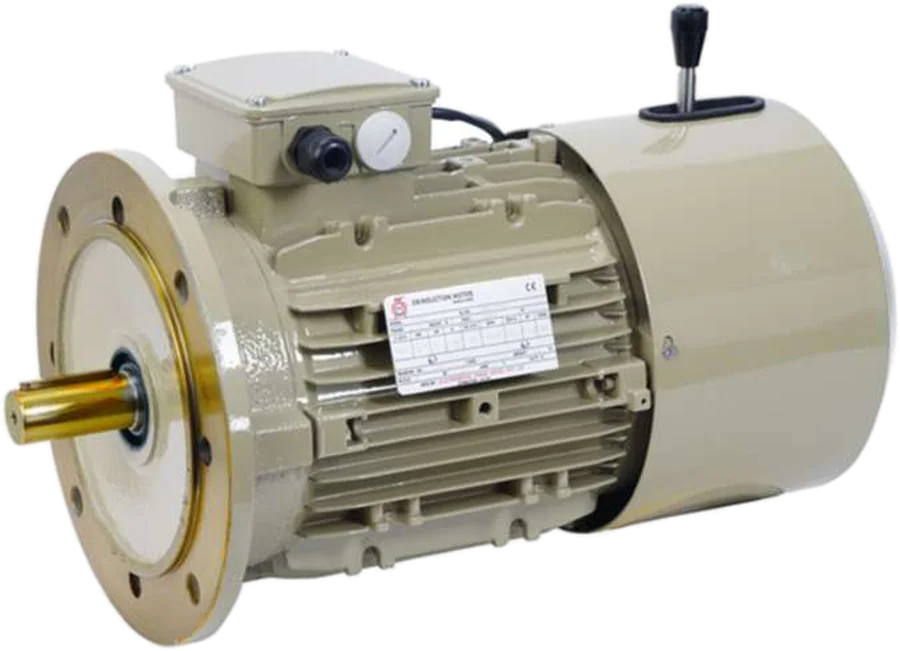
Brake torque sizing
Rated motor torque × the safety factor for the duty gives the brake torque. We suggest the smallest standard EMPD brake that covers it.
Also check thermal capacity: the permitted energy per stop falls as stops per hour rise. Our engineers confirm every hoist selection.
Motor current
I = P ÷ (√3 × V × η × cos φ) for three-phase; I = P ÷ (V × η × cos φ) for single-phase.
Unit converter
The conversions used throughout EMPD datasheets.